

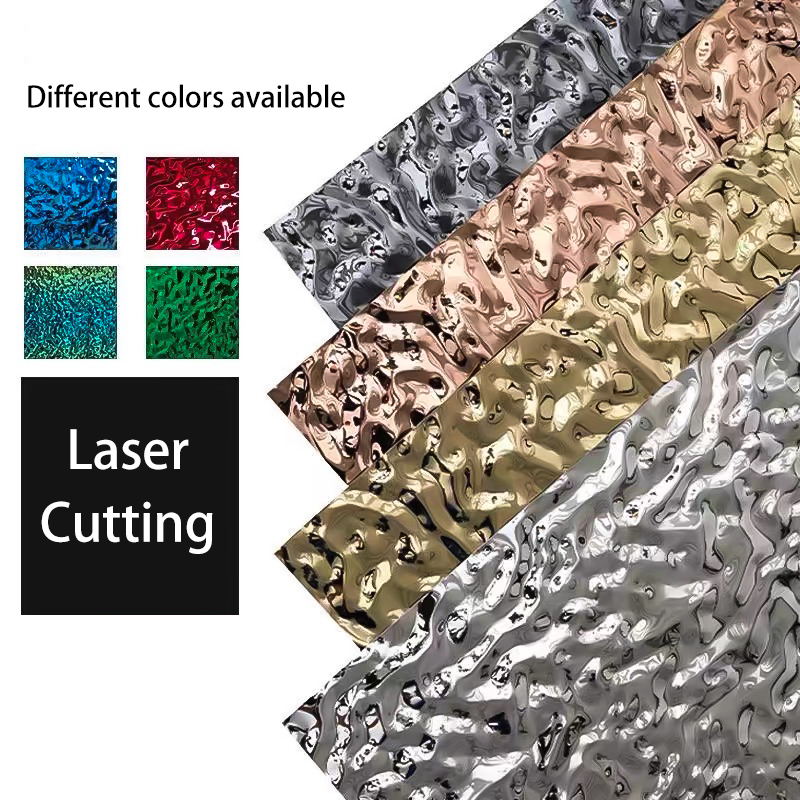
Stop Distortion! How to Prevent Mirror Stainless Steel Panel from Deformation After Installation
You’ve invested in high-quality mirror stainless steel sheets for a hotel lobby, elevator cabin, or luxury villa. The material arrives in perfect condition—flawless reflection, no waves, no ripples.
Then comes installation. And the nightmare begins.
The once-perfect mirror surface now shows water ripple effects, ghostly waves, or even visible bulges. What went wrong?
In this guide, we’ll uncover the 5 most common causes of mirror stainless steel sheet deformation—and exactly how to prevent them.
https://www.alibaba.com/product-detail/W01-Gold-Water-Ripple-Stainless-Steel_1601723079921.html
The Problem: Water Ripple Effect on Mirror Stainless Steel
The “water ripple effect” (also called orange peel or oil canning) refers to visible distortions in a reflective surface. Unlike scratches or dents, these distortions appear as soft, wavy patterns that move as you walk past.
On a mirror finish stainless steel sheet, any imperfection is magnified. What’s invisible on a brushed finish becomes glaringly obvious on a No. 8 mirror surface.
The hard truth: Most deformation issues are not material defects. They are installation mistakesor substrate problems.
5 Common Causes of Mirror Panel Deformation
Cause #1: Uneven Substrate Surface
The single most common cause.
Mirror stainless steel sheets are typically 0.6mm to 1.5mm thick. They will faithfully reflect every imperfection of the surface behind them. If your backing wall has humps, dips, or uneven adhesive application, the mirror panel will show every single one.
Typical scenario: A drywall surface with uneven joint compound application → water ripple effect appears exactly over every joint.
Solution: Before installing any decorative stainless steel mirror sheet, ensure the substrate is:
-
Flat within ±1mm per meter
-
Free from bumps, voids, or adhesive globs
-
Sanded smooth if using drywall
Cause #2: Improper Adhesive Application
This is the second most common culprit.
Using dot-and-dab adhesive application (placing adhesive in scattered spots rather than full coverage) creates pressure points. The mirror sheet is pulled tighter at adhesive spots, leaving looser areas in between. The result? Visible ripples exactly where the adhesive sits.
Wrong method: Five dabs of construction adhesive
Right method: Full sheet coverage using roller-applied contact adhesive or structural film
Solution: Always specify full-coverage adhesive application for mirror finish stainless steel sheets. For elevator interiors, consider pressure-sensitive adhesives (PSA) with solid backing.
Cause #3: Thermal Expansion Mismatch
Stainless steel expands and contracts with temperature changes—approximately 0.017mm per meter per degree Celsius.
If a mirror panel is rigidly fixed at all four edges, thermal expansion has nowhere to go. The material buckles outward, creating visible waves.
Typical scenario: A large wall panel (2m+ wide) riveted or screwed tightly around all four edges → first hot day → expansion forces panel to bow.
Solution: Use a floating installation system:
-
Secure panel at top and bottom only
-
Allow side edges to float within a receiving channel
-
Or use silicone gap fillers that accommodate movement
Cause #4: Insufficient Panel Thickness for Application
Thinner panels are more prone to telegraphing substrate imperfections.
| Thickness | Recommended Application |
|---|---|
| 0.6mm | Ceilings, low-touch decorative accents |
| 0.8mm–1.0mm | Wall panels on perfect substrates |
| 1.2mm–1.5mm | Elevator walls, high-traffic areas |
| 2.0mm+ | Flooring, high-impact zones, or problematic substrates |
Solution: If your substrate cannot be made perfectly flat, increase panel thickness. A 1.5mm mirror stainless steel sheet is far more forgiving than a 0.8mm sheet.
Cause #5: Handling Damage Before Installation
Mirror sheets are vulnerable before they are secured.
Bowing the panel during transport, leaning it unevenly against a wall, or flexing it during positioning can cause permanent deformation. Once a mirror surface is bent, you cannot simply “flatten it back”—the distortion remains.
Solution: Establish strict handling rules:
-
Always store mirror panels flat or vertically on A-frames
-
Never lean panels at angles
-
Use suction lifters for large panels
-
Two-person minimum for any panel over 1.5m
Quick Reference: Pre-Installation Checklist for Mirror Panels
Before installing any stainless steel mirror sheet for elevator interior or wall panel, verify:
| Item | Checkpoint |
|---|---|
| ☐ Substrate flatness | ≤1mm per meter variation |
| ☐ Adhesive method | Full coverage, not dot-and-dab |
| ☐ Panel thickness | ≥1.2mm for high-visibility areas |
| ☐ Mounting system | Allows thermal movement |
| ☐ Panel inspection | No pre-existing waves or bends |
| ☐ Handling plan | Two-person carry, no flexing |
Case Study: How a Hotel Fixed Its “Wavy Mirror Wall”
The problem: A newly renovated hotel elevator lobby installed 0.8mm mirror stainless steel sheets on drywall. After completion, every elevator showed prominent water ripple effects.
Investigation findings:
-
Substrate had uneven joint compound
-
Adhesive was applied in spots
-
Panels were too thin for the application
The fix:
-
Removed mirror panels
-
Ground substrate to flatness within 0.5mm/meter
-
Upgraded to 1.2mm mirror finish sheets
-
Reinstalled with full-coverage structural adhesive
Result: Perfect reflection. No ripples. Hotel accepted the renovation.
Cost of not doing it right first time: 2x material + 3x labor + project delay
Frequently Asked Questions
Q: Can I install mirror stainless steel over existing tiles?
A: Not recommended. Tile grout lines will telegraph through thin mirror sheets. Remove tiles or install a flat backing board first.
Q: Does laser cutting cause edge warping?
A: High-speed laser cutting can introduce heat-affected zone (HAZ) warping on thin sheets. Specify waterjet cutting or low-heat laser parameters for mirror finishes.
Q: How do I check substrate flatness before installation?
A: Use a 2-meter straightedge. Any gap larger than 1mm indicates an issue.
Q: Can I bend mirror stainless steel on-site?
A: Only with proper press brakes and protective films. On-site bending almost always damages the mirror surface.
Conclusion
Water ripple effect and deformation are not inevitable. They are preventable with proper planning:
-
Start with a flat substrate
-
Use full-coverage adhesive
-
Choose sufficient thickness
-
Allow for thermal movement
-
Handle carefully before installation
Share this guide with your installation team. One hour of preventive planning saves days of rework.
When you order your next decorative stainless steel mirror sheet, ask about our pre-installation consultation—we’ll help you avoid these five mistakes.