

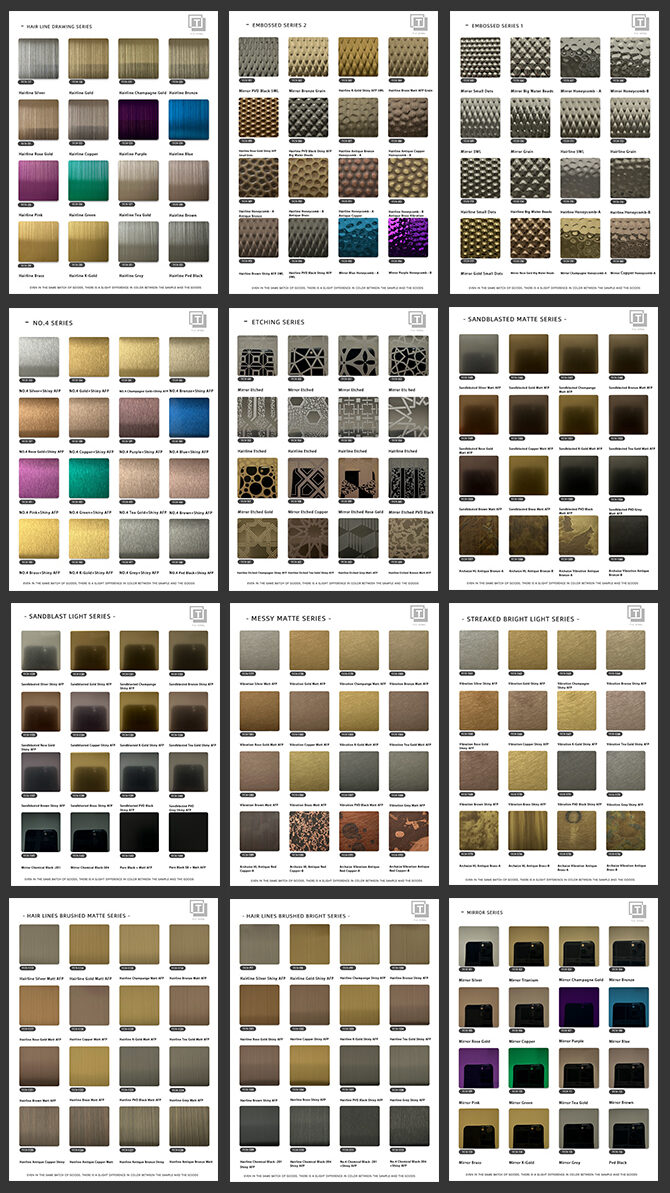
Stainless Steel Surface Finish Cost: Compare 6 Types for Your Project
Understanding stainless steel surface finish cost is essential for any hotel procurement manager, interior designer, or villa owner planning a decorative panel project. Different finishes come with dramatically different price points. Therefore, knowing what drives these costs helps you maximize visual impact while staying within budget.
Why Do Surface Finishes Have Different Costs?
The stainless steel surface finish cost varies primarily due to three factors: processing time, material waste, and production complexity. A simple brushed finish requires one pass through abrasive belts. A mirror finish demands multiple progressive polishing steps. A titanium coated finish adds expensive PVD equipment and longer cycle times.
For example, producing one square meter of mirror finish takes approximately 3-5 minutes of polishing time. The same area of brushed finish takes under 1 minute. Consequently, mirror finishes cost significantly more than brushed finishes.
On the other hand, custom etched finishes require design time, chemical or laser processing, and careful quality control. Therefore, they occupy the highest price tier among all finishes.
Cost Overview: 6 Surface Finishes Compared
| Finish | Relative Cost (1.0x = lowest) | Cost per m² (estimate) | Main Cost Driver |
|---|---|---|---|
| Brushed (No.4) | 1.0x | $ | Simple mechanical process |
| Hairline | 1.1x | $ | Fine abrasives, consistent grain |
| Mirror (No.8) | 1.5x – 1.8x | $$ | Multiple polishing steps |
| Perforated | 1.8x – 2.5x | $$ | Material loss + punching time |
| Embossed | 2.0x – 3.0x | $$$ | Roller tooling + minimum orders |
| Etched | 2.5x – 4.0x | $$$ | Design + chemical/laser processing |
| Titanium Coated | 3.0x – 5.0x | $$$$ | PVD equipment + color consistency |
Note: Actual stainless steel surface finish cost varies by supplier, order quantity, and base material grade. Larger orders reduce per-unit costs significantly.
Detailed Cost Breakdown by Finish
Brushed Finish (No.4) – Baseline Cost
The brushed finish serves as the cost baseline because it requires the simplest processing. The stainless steel sheet passes through abrasive belts once to create a uniform grain pattern.
Cost factors:
-
Single processing step
-
Standard equipment, widely available
-
Minimal material waste
-
Fast production speed
Best value for: High-traffic areas, large projects, budget-conscious buyers
Estimated premium above base material: 0-5%
For example, a standard 1.2mm 304 sheet with brushed finish costs only slightly more than the same sheet with no finish (mill finish).
Internal Link (Dofollow): For application guidance on brushed finishes, read our Stainless Steel Decorative Sheet Surface Guide.
Hairline Finish – Slightly Above Baseline
The hairline finish is similar to brushed but requires finer abrasives and more careful grain alignment. Therefore, it carries a small premium over standard brushed.
Cost factors:
-
Finer abrasives cost more
-
Slower line speed for consistent grain
-
Higher rejection rate for visible flaws
Estimated premium above base material: 5-10%
Best value for: Elevator doors, appliance panels, areas needing subtle elegance
Mirror Finish (No.8) – Moderate Premium
The mirror finish requires significant processing time and skilled operators. Consequently, the stainless steel surface finish cost for mirror is considerably higher than brushed.
Cost factors:
-
Multiple polishing steps (3-5 stages)
-
Progressively finer abrasives
-
Skilled labor required
-
Higher risk of scratches during production
Estimated premium above base material: 50-80%
Why the premium is worth it: Mirror finishes create dramatic visual impact that no other finish can match. For elevator interiors and hotel lobbies, this investment typically pays off in perceived luxury value.
For instance, a 1.2mm 304 mirror sheet might cost 60% more than the same brushed sheet. However, a hotel lobby using mirror panels commands higher room rates and creates stronger guest impressions.
Internal Link (Dofollow): For mirror thickness selection guidance, review our Mirror Sheet Thickness Guide.
Perforated Finish – Material Loss Adds Cost
Perforated finishes involve punching holes in the sheet. The stainless steel surface finish costhere is driven primarily by material loss rather than processing time.
Cost factors:
-
20-50% of material becomes waste (holes)
-
Punching tooling costs
-
Slower production speed
-
Edge burr removal may be required
Estimated premium above base material: 80-150%
Value consideration: Perforated sheets serve specific functions (acoustics, ventilation) that no other finish can provide. Therefore, the cost is justified by function rather than appearance.
On the other hand, if you only need visual texture without actual holes, embossed or etched finishes may offer better value.
Embossed Finish – Tooling Drives Cost
Embossed finishes create raised or recessed patterns using roller presses. The stainless steel surface finish cost for embossed sheets is heavily influenced by tooling amortization.
Cost factors:
-
Expensive roller tooling (5,000−20,000 per pattern)
-
Tooling cost spread across order quantity
-
Higher force equipment required
-
Pattern consistency requires precision setup
Estimated premium above base material: 100-200%
How to get better value: Order larger quantities to spread tooling cost. A 500-sheet order might have half the per-unit cost of a 100-sheet order.
Best value for: Large hotel projects, chain-wide branding, repeating patterns
Etched Finish – Customization Drives Cost
Etched finishes offer unlimited design possibilities but at a significant price premium. The stainless steel surface finish cost for etching reflects the custom nature of the process.
Cost factors:
-
Design and artwork preparation
-
Chemical or laser etching equipment
-
Masking and selective removal process
-
Quality inspection for fine details
-
Longer lead times (2-4 weeks typical)
Estimated premium above base material: 150-300%
Example cost scenario: A simple geometric pattern etched across 50 square meters might add 150% to material cost. A highly detailed custom logo design on 10 square meters might add 300% or more.
However, etched finishes create unique, artistic results that distinguish luxury properties. For high-end villas and boutique hotels, this investment creates distinctive identity.
For instance, a villa owner spending $50,000 on elevator cabin materials might allocate 20% to etched feature panels that become the cabin’s signature design element.
Titanium Coated Finish – Premium Color Option
Titanium coated (PVD) finishes occupy the highest price tier. The stainless steel surface finish cost for titanium reflects sophisticated equipment and strict quality requirements.
Cost factors:
-
PVD vacuum equipment (high capital cost)
-
Color consistency requires precise control
-
Multiple color options require separate runs
-
Surface must be perfect before coating
-
Longer production time
Estimated premium above base material: 200-400%
Color cost variations:
-
Gold and rose gold: lowest premium (most common)
-
Bronze and champagne: moderate premium
-
Black and blue: higher premium (more difficult to achieve consistently)
Value consideration: Titanium coated finishes offer durability that painted or plated finishes cannot match. Therefore, for exterior applications or high-wear interior areas, the premium may be justified by longevity.
On the other hand, for low-traffic interior areas where color is only needed for a few years, consider alternatives like laminated or painted finishes at lower cost.
Internal Link (Dofollow): For titanium coating durability details, see our Stainless Steel Decorative Sheet Surface Guide.
Cost vs. Value: Making Smart Trade-offs
Understanding stainless steel surface finish cost is only half the equation. The other half is value—what do you gain for the additional expense?
| Finish | Cost Premium | Value Gained | Best When… |
|---|---|---|---|
| Brushed | Lowest | Durability, low maintenance | Budget is primary concern |
| Mirror | Moderate | Visual drama, space amplification | First impressions matter most |
| Etched | High | Uniqueness, artistic detail | Custom design is required |
| Titanium | Highest | Color, prestige, durability | Brand identity needs color |
For example, a hotel might use brushed finishes for back-of-house areas, mirror finishes for lobby feature walls, and titanium accents for VIP elevator cabins. This approach balances total project cost while creating impact where it matters most.
Quantity Impact on Surface Finish Cost
Order volume significantly affects stainless steel surface finish cost per square meter. The table below shows approximate cost reduction at different volumes.
| Finish | 50 m² | 200 m² | 1000 m² |
|---|---|---|---|
| Brushed | 1.0x | 0.9x | 0.8x |
| Mirror | 1.0x | 0.8x | 0.7x |
| Embossed | 1.0x | 0.6x | 0.4x |
| Etched | 1.0x | 0.7x | 0.5x |
| Titanium | 1.0x | 0.8x | 0.6x |
Consequently, embossed and etched finishes become much more attractive at larger volumes because the fixed tooling and setup costs are spread across more units.
Therefore, if your project requires 500+ square meters of a custom pattern, etching or embossing may be surprisingly affordable per unit.
Hidden Costs to Consider Beyond Surface Finish
The stainless steel surface finish cost is not the only expense. Consider these additional factors when budgeting:
| Additional Cost | Impact | Mitigation |
|---|---|---|
| Protective film | Mirror and titanium finishes require premium film (+5-10%) | Specify standard film for brushed |
| Packaging | Mirror finish needs interleaving paper and edge protection | Combine orders to share packaging cost |
| Shipping | Heavier gauges cost more to ship | Consolidate orders, use sea freight |
| Installation | Mirror finish requires more careful handling (+labor time) | Train installers or use thicker gauge |
| Replacement risk | Custom finishes difficult to match if damaged | Order 5-10% spare material |
For example, a titanium coated panel damaged during installation cannot be matched exactly from a second production run. Therefore, always order spare material for custom finishes.
Quick Reference by Buyer Type
| Buyer | Recommended Finish | Typical Budget per m² |
|---|---|---|
| Hotel procurement (large chain) | Brushed for most areas; Mirror for lobby; Titanium for accents | $ – $$ |
| Boutique hotel owner | Etched feature walls; Mirror for public areas | $$ – $$$ |
| Elevator manufacturer | Hairline for standard; Mirror for premium models | $ – $$ |
| Villa owner | Mirror or Titanium for impact areas; Brushed elsewhere | $$ – $$$ |
| Interior designer | Varies by client; often mixed finishes | $-$$$$ |
| Restaurant owner | Brushed for durability; Perforated for acoustics | $ – $$ |
Cost-Saving Strategies Without Sacrificing Quality
Strategy 1: Mix finishes strategically
Use premium finishes only on accent areas. A full wall of titanium is expensive. A titanium border or feature strip costs much less but still draws the eye.
Strategy 2: Order larger quantities
Consolidate multiple projects into one order. A hotel renovating 20 floors can order all material at once to achieve volume pricing.
Strategy 3: Choose standard sizes
Custom cut sizes increase waste and cost. Order standard sheet sizes and cut locally when possible.
Strategy 4: Plan ahead
Rush orders add 15-30% premium. Etched and titanium finishes need 3-6 weeks lead time. Plan accordingly.
Strategy 5: Request samples before full order
Testing a finish on your actual application prevents expensive mistakes. Sample costs are minimal compared to reordering.
Frequently Asked Questions
Q: Which finish offers the best value for a tight budget?
A: Brushed (No.4) finish offers the lowest stainless steel surface finish cost while providing excellent durability and appearance for most applications.
Q: Is mirror finish worth the 50-80% premium?
A: For high-visibility areas like hotel lobbies and elevator cabins, yes. For back-of-house or low-traffic areas, no. Match premium finishes to premium locations.
Q: Why is titanium coating so expensive?
A: PVD equipment costs millions, color consistency requires skilled operators, and production is slower than mechanical finishes. Therefore, titanium is a premium product for premium applications.
Q: Can I get etched finish samples before committing to large order?
A: Yes. Reputable suppliers offer sample panels for a small fee, often credited against your final order. Always request samples for custom finishes.
Q: Does stainless steel surface finish cost vary by grade (304 vs 316)?
A: Yes. Finishing costs apply on top of base material cost. 316 costs more than 304 regardless of finish. Therefore, specify 316 only when corrosion resistance is required (coastal, exterior, pool areas).
Conclusion
Understanding stainless steel surface finish cost helps you allocate budget effectively. Brushed finishes offer the best value for high-traffic and large-area applications. Mirror finishes justify their premium in high-visibility locations. Etched and titanium finishes create unique, memorable spaces but should be used selectively.
Therefore, follow this simple cost-value rule:
Use the lowest-cost finish that meets your visual requirements for each area. Invest premiums only where they create measurable value—guest impressions, brand identity, or unique design.
For example, a hotel might spend 70% of its decorative metal budget on 20% of its surface area (lobby, VIP elevator). The remaining 80% of area uses cost-effective brushed finishes. This approach maximizes impact while controlling total project cost.
